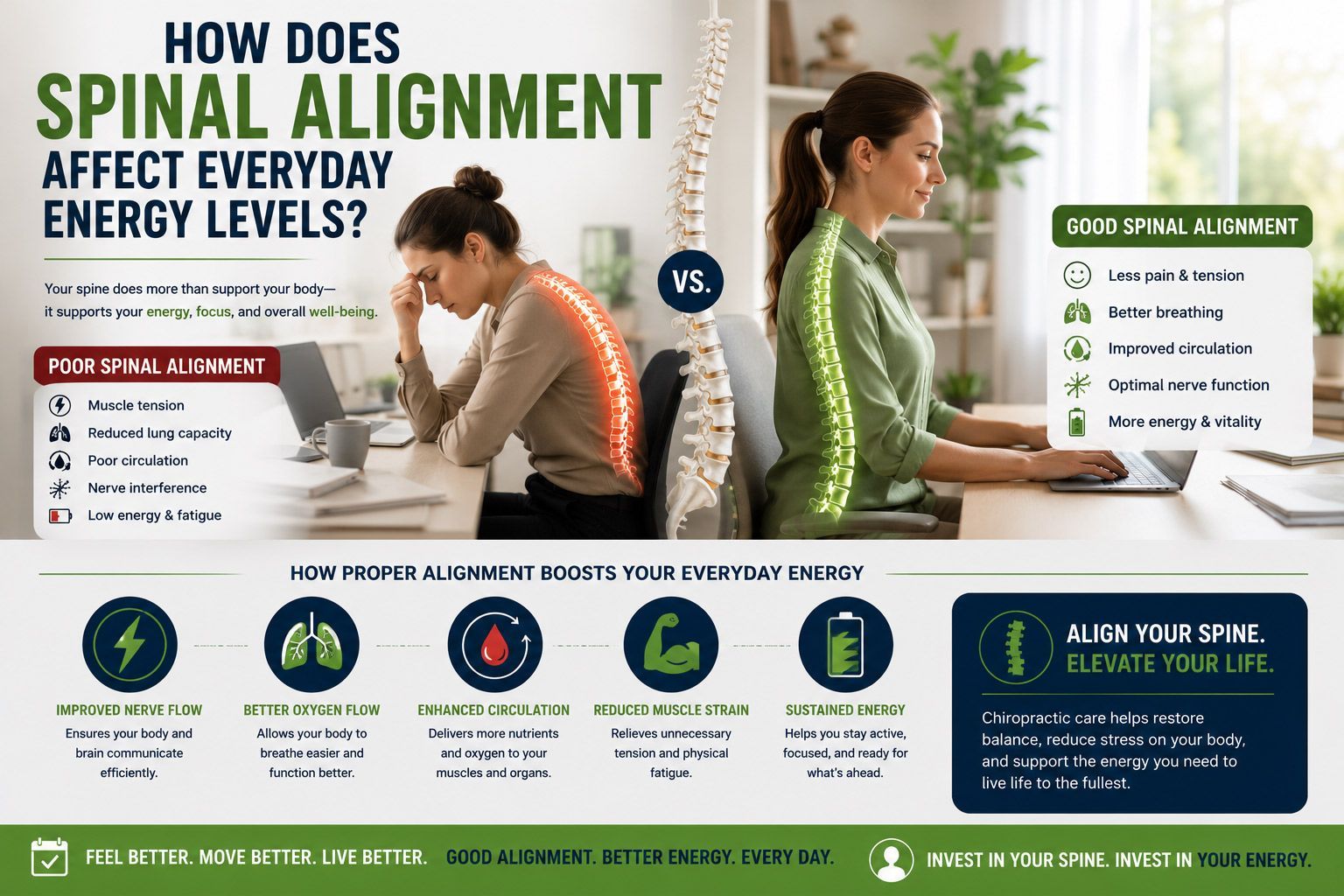
Can Chiropractic Care Help Desk Workers Avoid Chronic Pain?
April 5, 2026
Introduction
Desk work looks harmless. You sit, you type, you stare at a screen. There’s no heavy lifting, no impact, no visible strain. Yet millions of office workers develop chronic neck pain, lower back stiffness, headaches, wrist tension, and shoulder tightness that never quite goes away.
What makes desk pain dangerous is its subtlety. It builds quietly, day after day, until discomfort becomes your normal. Chiropractic care is often seen as a reaction to injury—but for desk workers, it can function as prevention. The question is not whether sitting causes strain. It’s whether that strain can be interrupted before it becomes permanent.
Why Desk Work Creates Chronic Pain
Desk pain is not about one bad posture moment. It is about repetition.
Most desk workers spend:
- Hours with their head tilted forward
- Long periods with rounded shoulders
- Entire days with hips locked in flexion
- Weeks without meaningful spinal movement
This pattern changes how joints move, how muscles fire, and how the nervous system interprets position. Over time, the body adapts to stress instead of correcting it.
Pain appears when adaptation fails.
How Chiropractic Addresses Desk-Related Strain
Chiropractic care targets the mechanical patterns that desk work creates.
It focuses on:
- Restoring joint movement in the spine
- Reducing nerve irritation caused by compression
- Rebalancing motion between stiff and overworked areas
- Interrupting postural drift before it hardens
Desk pain is rarely caused by one structure. It is systemic. Chiropractic works at that same systemic level.
Instead of masking symptoms, it resets how the body moves.
Where Desk Workers See the Biggest Gains
Chiropractic care tends to help most in three areas.
Neck and Upper Back Tension
Forward head posture loads the cervical spine. Adjustments restore motion and reduce compression that contributes to headaches and stiffness.
Lower Back Compression
Prolonged sitting reduces lumbar movement. Care reintroduces motion and unloads joints that become static under desk habits.
Shoulder and Mid-Back Fatigue
Rounded posture limits thoracic mobility. Chiropractic improves rib and upper-spine movement, allowing shoulders to rest instead of brace.
These changes reduce daily accumulation of strain.
Prevention Versus Reaction
Most desk workers seek care only after pain becomes disruptive.
The difference between reactive and preventive care is timing.
| Approach | When Care Starts | Outcome |
|---|---|---|
| Reactive | After pain interferes | Slower recovery |
| Preventive | Before pain dominates | Faster correction |
| Episodic | Only during flare-ups | Recurring cycles |
| Consistent | At early warning signs | Long-term stability |
Chronic pain is not a sudden event. It is a pattern that goes unchallenged.
Chiropractic care works best when it interrupts that pattern early.
What Chiropractic Cannot Replace
Chiropractic does not replace:
- Ergonomic setup
- Movement breaks
- Physical activity
- Postural awareness
It complements them.
A perfect chair cannot undo eight hours of stillness. A standing desk cannot fix restricted spinal joints. Chiropractic does not make bad habits harmless—it reduces their cumulative impact.
A Practical Desk-Worker Strategy
A realistic prevention approach looks like this:
- Notice early signals: stiffness, tightness, recurring soreness
- Adjust your workstation to reduce strain
- Add small movement breaks during the day
- Use chiropractic care to restore lost motion
- Let consistency replace crisis-driven visits
This treats desk work as a mechanical stressor, not a moral failure.
Frequently Asked Questions
Is desk pain really structural?
Yes. Sitting changes joint movement and muscle balance over time.
Can chiropractic prevent pain entirely?
It reduces risk and intensity. No care removes the need for movement.
Do I need constant visits?
Not for everyone. Many desk workers transition to periodic care.
Will one adjustment fix posture?
No. Posture is a habit. Care restores mobility so habits can change.
Is chiropractic only for severe pain?
No. It is most effective before pain becomes severe.
Conclusion
Desk work does not injure the body all at once. It reshapes it slowly. Chronic pain emerges when that reshaping goes unchallenged. Chiropractic care gives desk workers a way to interrupt the process, restoring movement before stiffness becomes identity. It does not replace movement, ergonomics, or awareness—it reinforces them. For many Cary professionals, clinics like Crack Shack Chiropractic make this kind of preventive care accessible, helping office workers stay functional instead of waiting for pain to force change.